The Problem
Rural Tennesseans get world-class care in the city — then go home with no record of it.
89 of Tennessee’s 95 counties are rural. Patients travel to Nashville, Memphis, Knoxville, Chattanooga, and Johnson City for advanced procedures, then return to communities where 13 rural hospitals have closed since 2010 and 22 counties have no hospital at all.
A gap measured in real encounters
-
No discharge summary at follow-up
66–88% of rural primary care physicians do not have access to a discharge summary at the first post-hospitalization visit.
-
Communication failures at the handoff
20–40% of discharged patients experience at least one significant communication failure during the transition to outpatient care.
-
Medication errors follow
Medication discrepancies occur in 30–70% of patients after hospital discharge — a direct consequence of information that didn’t travel with the patient.
And it’s worse for implanted devices
-
Fragmented vendor landscape
Health systems work with hundreds to thousands of vendors and manage hundreds of thousands of implanted medical devices annually.
-
No end-to-end traceability
There is a persistent lack of standardized tracking for implantable devices, compromising safety, recall management, and long-term outcomes.
-
Misaligned incentives
Current systems prioritize transactional volume over value, leading to inefficiencies, excess inventory, and patient disengagement.
-
No neutral infrastructure
The industry lacks a centralized, vendor-agnostic platform that serves the interests of all stakeholders fairly.
Disconnected patients in a digital world
-
Outdated tracking
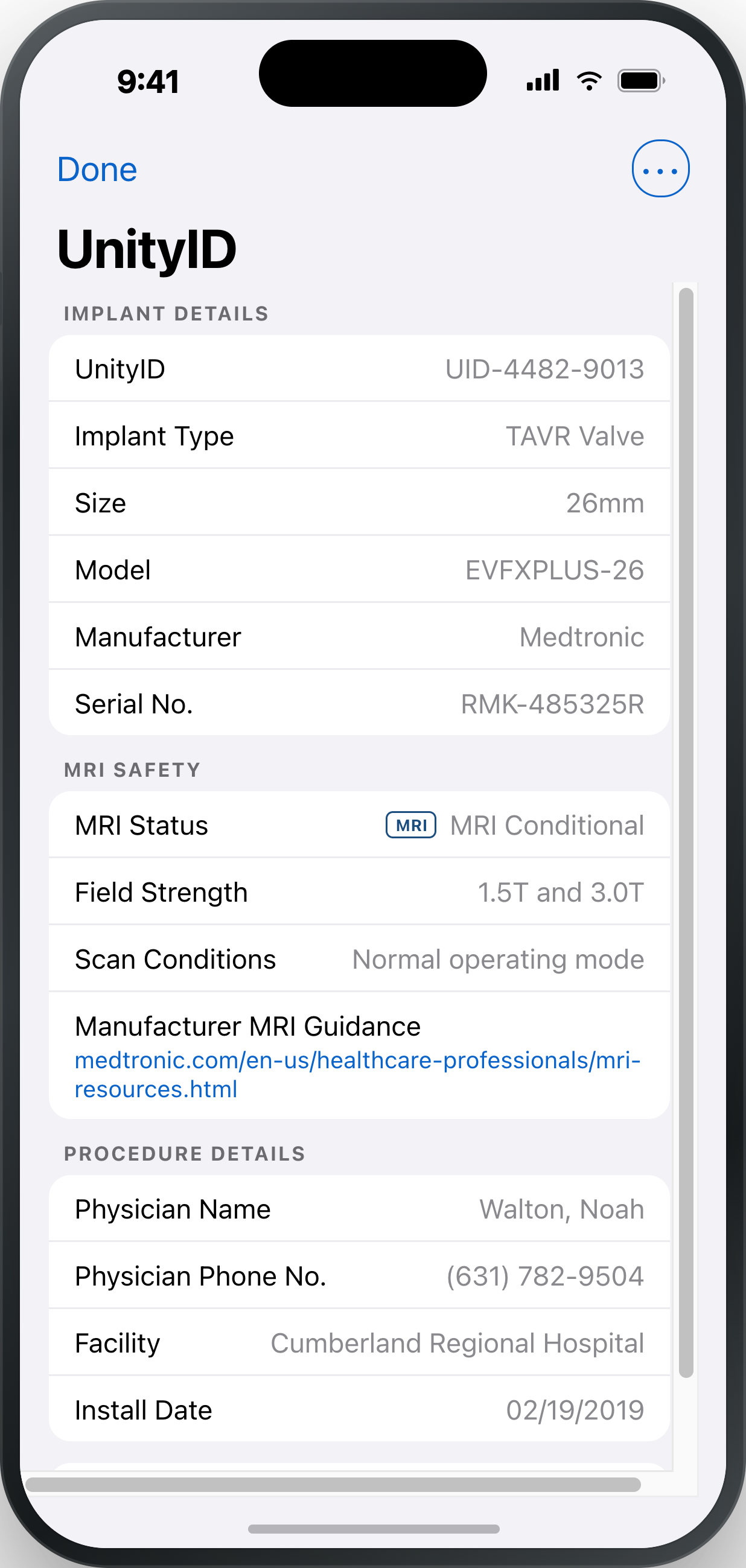
Patients with permanently implanted devices are still issued physical implant cards — a decades-old method of documentation, sometimes delivered months or even a year after implantation.
-
Low retention and awareness
Most implant cards are lost within 3 years, and the majority of patients don’t know what device they have or why it matters.
-
High prevalence, low engagement
Over 30% of adults aged 40+ in the U.S. have at least one permanent metal implant, yet few are meaningfully engaged in tracking or understanding their implant data.
Why digital-first matters
The smartphone is the greatest source of connectivity
Reliance on smartphones for going online among lower-income Americans has roughly doubled since 2013, and 76% of adults earning under $30K now own one — far outpacing home broadband or desktop access in that group (Pew Research Center). A device record that only lives on paper, or only works on a desktop, misses the patients who need it most.